
close
Choose Your Site
Global
Social Media


The shift of green hydrogen projects from pilot programs to global supply chains presents a major hurdle. We must overcome a critical bottleneck: energy-dense storage. High-pressure gaseous storage up to 700 bar is simply insufficient. It requires massive land footprints and heavy cylinders. This reality makes grid-scale energy reserves, heavy-duty transport, and international trade practically impossible.
Deep cryogenic storage at -253°C solves this problem. It reduces physical volume drastically. However, this extreme environment introduces complex thermal, material, and safety engineering challenges. You cannot treat liquid hydrogen like conventional fuels. It demands highly specialized handling.
This guide breaks down the engineering realities, risk mitigation strategies, and evaluation criteria for integrating a Cryogenic Tank into large-scale hydrogen infrastructure. You will learn exactly how to evaluate thermal designs. We will also explore how to deploy these advanced systems safely across industrial sites.
Density vs. Efficiency: Liquid hydrogen offers a 1/800 volume reduction compared to gas, justifying the 30–40% energy penalty incurred during the liquefaction process.
BOG Mitigation is Critical: Managing Boil-Off Gas (BOG) requires addressing heat leaks, sloshing, and the exothermic ortho-to-para conversion of hydrogen molecules.
Advanced Insulation: State-of-the-art cryogenic liquid storage tanks rely on Multi-Layer Insulation (MLI) and deep vacuums (<1 micron) to maintain thermal stability.
Strict Compliance: Deployment requires adherence to ASME/DOT standards, specialized leak detection, and strict site spacing (e.g., DOE’s 25-foot clearance rules).
Storing hydrogen poses a unique physical paradox. Mass-wise, hydrogen holds incredible energy. Volumetrically, it is incredibly sparse. You must choose between compressing it at dangerous pressures or freezing it into a dense liquid. The business case for large-scale energy projects strongly favors the liquid route.
Compressed gas systems face severe physical limits. They require thick-walled, heavy composite cylinders. These cylinders occupy massive amounts of physical space. They also fail to deliver optimal energy density.
Liquid hydrogen achieves approximately 8 MJ/L. Compressed gas provides vastly lower volumetric energy density. This physical limitation destroys the viability of long-distance transport. You simply cannot fit enough gaseous fuel onto a ship or truck to make international trade profitable.
Creating liquid hydrogen is not free. Cooling hydrogen gas down to −253.8°C (20 K) demands immense power. The process consumes roughly 30–40% of the hydrogen’s usable energy value. This creates an initial energy penalty.
Why is it worth it? The resulting 1/800 volume reduction changes the entire logistics equation. It enables high-capacity international trade. It supports aerospace deployment. It makes zero-emission heavy transport possible. Gaseous pipelines or compressed trailers simply cannot support these heavy-duty applications.
Storage Method | Operating State | Volumetric Density | Primary Use Case |
|---|---|---|---|
Compressed Gaseous | 350 to 700 bar (Ambient Temp) | Extremely Low | Light passenger vehicles, short transit |
Deep Cryogenic | Low Pressure (-253°C) | High (Approx. 8 MJ/L) | Grid storage, international shipping, heavy trucks |
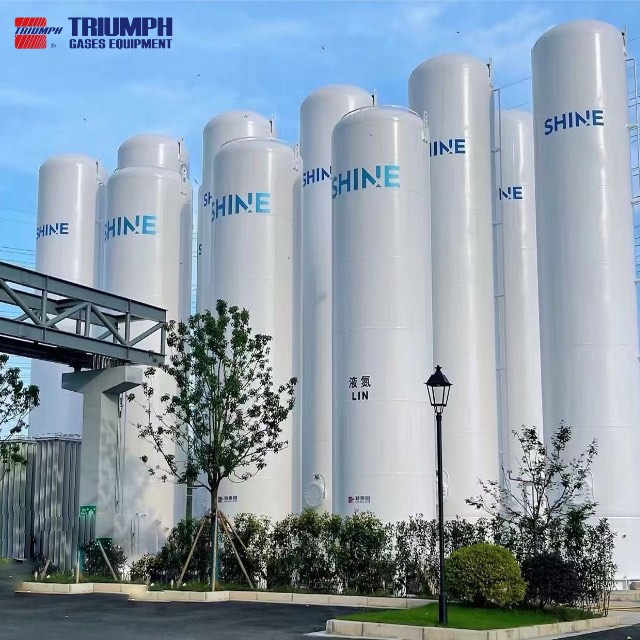
We often describe a cryogenic liquid storage tank as a giant thermos. It utilizes a highly specialized double-walled design. This structure prevents ambient heat from destroying the super-cooled fuel inside.
Engineers design these vessels in two distinct layers. Each layer serves a critical, independent function.
Inner Vessel: This layer makes direct contact with the liquid hydrogen. Standard metals become brittle like glass at -253°C. Therefore, manufacturers require specialized materials. They typically use austenitic stainless steel or specialized aluminum. These metals resist cryogenic hydrogen embrittlement.
Outer Vessel: This outer jacket does not touch the fuel. Instead, it provides structural integrity. It contains the vacuum insulation envelope. It protects the inner vessel from physical impacts and environmental factors.
Stopping heat transfer is the hardest engineering challenge. Engineers must block conduction, convection, and radiation simultaneously.
They achieve this through Multi-Layer Insulation (MLI). MLI uses alternating layers of aluminum foil and glass fiber paper. The foil reflects radiant heat. The glass paper separates the foil to prevent direct conduction.
Next, technicians apply a high vacuum. They draw the annular space between the vessels down to 1 micron (10^-4 mbar). This extreme vacuum eliminates convective and conductive heat transfer. Without air molecules to carry heat, the inner vessel remains thermally isolated.
Insulating the tank is only half the battle. You must extract the fuel safely. Standard pipes will instantly freeze ambient moisture and boil the hydrogen inside.
Facilities mandate the use of Vacuum Jacketed Piping (VJP). VJP surrounds all external transfers with a vacuum barrier. This prevents flashing and product loss during routing. It ensures the fuel reaches the end-use point in a pure liquid state.
Maintaining thermal stability requires constant vigilance. Even minute heat ingress causes severe problems. Liquid hydrogen possesses an exceptionally low latent heat of vaporization. It sits at just 447 kJ/kg. Because of this, small heat leaks cause the liquid to flash rapidly into gas. This creates Boil-Off Gas (BOG).
Hydrogen molecules exist in two distinct nuclear spin states. We call them ortho and para. At room temperature, hydrogen is 75% ortho and 25% para. However, at -253°C, the physics change. The liquid naturally shifts to 100% para.
This conversion poses a massive engineering threat. The shift is highly exothermic. It releases 527 kJ/kg of heat. This generated heat exceeds the energy required to vaporize the liquid itself. If you store untreated hydrogen, the liquid will literally boil itself from the inside out.
The solution requires advanced chemistry. Liquefaction processes must utilize specialized catalysts. These catalysts force the ortho-to-para conversion before the fuel enters storage. Addressing this conversion early prevents massive BOG inside the container.
Engineers manage BOG through two primary thermal strategies. Project managers must select the right approach based on storage duration.
Cooling Strategy | Mechanism | Best Application |
|---|---|---|
Passive Cooling | Relies purely on MLI, vacuums, and structural design. No moving parts. | Short-term transit, mobile logistics, ISO containers. |
Active Cooling | Integrates active cryocoolers to extract latent heat continuously. | Long-term grid energy storage, "zero-evaporation" bulk ports. |
Liquid hydrogen presents unique safety hazards. You must respect its chemical properties. It carries a broad flammability range of 4% to 7% in air. It requires an exceptionally low ignition energy. A simple static spark can ignite a massive vapor cloud. Furthermore, spilled liquid causes severe, immediate frostbite.
Safe operation requires overlapping safety layers. Single points of failure are unacceptable. System integrators must install several required components.
Redundant Safety Relief Valves: You must place these on both the inner vessel and external piping. They prevent catastrophic over-pressurization if the vacuum fails.
Pressure Building Units (PBU): Extracting liquid lowers internal pressure. PBUs maintain equilibrium during extraction. They do this without introducing atmospheric contaminants.
Advanced Sensor Arrays: Facilities require multi-spectrum flame detectors. They need specialized smoke sensors. They must deploy hydrogen-specific leak monitors capable of detecting parts-per-million variations.
Deploying these systems involves rigorous legal compliance. You cannot place a vessel randomly on an industrial site. Engineering teams must ensure strict adherence to the ASME Boiler and Pressure Vessel Code. Transport units must follow DOT transport guidelines.
Site layout dictates safety. The US Department of Energy (DOE) mandates strict minimum clearances. For example, facilities must maintain a 25-foot radius entirely free of weeds, trash, and combustibles. Comprehensive static grounding is mandatory to prevent spark ignition. Additionally, foundations and surrounding barrier walls must utilize exclusively non-combustible materials.
Selecting hardware partners requires technical scrutiny. Project developers must move past basic volume metrics. You must audit manufacturing techniques and lifecycle economics.
Evaluate vendor fabrication techniques thoroughly. Standard welding introduces severe vulnerabilities. For example, traditional MIG or TIG welding on aluminum can cause microcracks. Hydrogen molecules easily escape through these microscopic flaws.
You should demand advanced methods. Friction Stir Welding (FSW) provides a superior solution. FSW maintains 70–100% joint efficiency. It does not melt the metal. Instead, it plasticizes it. This prevents microscopic hydrogen leaks entirely.
Smart developers focus on long-term financial impacts. You must assess insulation degradation over a 20-year lifespan. Budgeting purely on initial purchase price is a common mistake.
Specifying advanced glass bubbles instead of standard perlite changes the financial equation. Glass bubbles increase the initial upfront CapEx. However, they degrade much slower. They drastically lower lifetime BOG financial losses. A cheaper vessel that vents valuable fuel constantly will destroy project profitability over a decade.
Green energy projects expand rapidly. Determine if the vendor provides a unified ecosystem. You will need 40m³ mobile ISO containers for early logistics. Later, you will need 10,000m³ stationary bulk tanks for port-side export.
Furthermore, verify their integration capabilities. Your storage must connect to high-pressure cryogenic pumps. These pumps must be capable of up to 875 bar output. End-use refueling stations rely on this pressure to service heavy transport vehicles.
Cryogenic storage is non-negotiable for scaling global green hydrogen infrastructure. It delivers the volumetric density required for international logistics. However, it demands rigorous engineering. Developers must actively manage thermal leakage, phase-change physics, and extreme safety parameters.
Project developers must take immediate action to secure reliable hardware. First, move beyond basic capacity requirements. Second, mandate proven zero-boil-off capabilities for stationary sites. Third, require advanced welding certifications like FSW for aluminum vessels. Finally, demand strict ASME and DOE compliance from all hardware partners to guarantee long-term operational safety.
A: Well-engineered static tanks utilizing high vacuum and MLI typically aim for a BOG rate of 0.01% to 0.05% per day, though active cooling can reduce this to near zero.
A: Gas cylinders are designed for immense pressure (350–700 bar) at ambient temperatures. Liquid hydrogen operates at low pressure but requires extreme thermal insulation (-253°C) and materials immune to cryogenic embrittlement.
A: Passive tanks do not, relying solely on insulation. However, long-term stationary storage for green energy grids typically utilizes active cryocoolers, which require a continuous, albeit highly efficient, power supply to maintain zero evaporation.


