
close
Choose Your Site
Global
Social Media


Hydrogen is rapidly becoming one of the world’s most promising sources of clean and renewable energy. As nations strive toward carbon neutrality and reduced dependence on fossil fuels, liquid hydrogen equipment plays a crucial role in enabling large-scale hydrogen production, storage, and distribution.
Unlike gaseous hydrogen, which requires vast storage space and complex pressurization systems, liquid hydrogen (LH₂) offers a compact, high-density, and efficient way to transport energy. However, handling hydrogen at cryogenic temperatures (around –253°C) demands specialized technologies — and that’s where liquid hydrogen equipment becomes indispensable.
This article explores what liquid hydrogen equipment is, how it works, its applications, safety standards, and why it will shape the future of clean energy.
Liquid hydrogen equipment refers to a specialized set of technologies and engineering systems designed to store, transport, vaporize, and regulate hydrogen in its cryogenic liquid state. Because hydrogen becomes a liquid only at extremely low temperatures (around –253°C), maintaining stable conditions throughout its storage and transfer process is critical. The core function of this equipment is to preserve hydrogen’s purity and density while ensuring safe handling, minimal evaporation loss, and operational reliability across various stages — from production and liquefaction plants to hydrogen refueling stations, aerospace systems, and fuel cell applications.
By enabling hydrogen to be efficiently liquefied, transported, and re-gasified, this equipment plays a central role in the hydrogen value chain. It bridges the gap between hydrogen generation and its end-use applications, making it possible to integrate hydrogen into global clean energy systems at industrial and commercial scales.
Component | Function | Typical Material | Operating Range |
Cryogenic Storage Tanks | Store hydrogen in liquid form under high vacuum insulation to prevent heat transfer and boil-off. | Stainless steel, aluminum alloy | –253°C |
Vaporizers | Convert liquid hydrogen into gaseous hydrogen for use in industrial or fueling applications. | Aluminum, copper | Up to +40°C |
Skid-Mounted Systems | Modular units integrating tanks, pumps, vaporizers, and control systems for flexible, compact operation. | Stainless steel frameworks | Integrated operation |
Pumps & Valves | Control hydrogen flow and pressure throughout the system to ensure stable performance. | Nickel alloys, cryogenic steel | Variable |
Transfer Pipelines | Facilitate the safe and efficient transfer of hydrogen between components or storage facilities. | Vacuum-insulated pipes | –250°C to ambient |
Together, these components form the foundation of modern hydrogen infrastructure. They ensure that hydrogen — one of the world’s lightest and most volatile elements — can be handled safely, transported efficiently, and delivered effectively for energy, mobility, and industrial applications.
The process begins with gaseous hydrogen cooled through cryogenic refrigeration cycles until it condenses into a liquid.
Hydrogen gas enters a liquefaction unit.
The system uses helium or nitrogen-based cooling loops to reach –253°C.
Once liquefied, hydrogen is stored in specialized vacuum-insulated tanks.
In storage, vacuum insulation and reflective barriers minimize heat transfer.
Dual-wall design with high vacuum prevents boiling.
Sensors monitor pressure and temperature in real-time.
Relief valves ensure safety against overpressure or venting.
Liquid hydrogen equipment enables safe movement from production facilities to consumption sites.
Transport trailers or ISO containers carry liquid hydrogen over long distances.
Pipelines and transfer pumps ensure continuous, leak-free flow.
Before use, liquid hydrogen is vaporized using ambient or water-bath vaporizers.
It is then delivered as gaseous hydrogen for power generation, mobility, or industrial processes.
Advanced equipment ensures the phase transition happens without energy loss.
Used to safely contain liquid hydrogen for days or weeks.
High vacuum, multilayer insulation.
Designed for minimal boil-off loss (<0.2% per day).
Used when hydrogen must be converted back to gas.
Ambient air vaporizers and steam-heated units are common.
Critical for hydrogen refueling stations and fuel cell power systems.
Include cryogenic trailers, portable tanks, and skid-mounted modules.
Designed for thermal efficiency and mobility.
EPC (Engineering, Procurement, and Construction) systems offer complete hydrogen handling solutions — from design to commissioning.
Such systems are increasingly in demand for large-scale hydrogen plants and renewable energy integration projects.
1. High Energy Density and Efficiency
Liquid hydrogen offers exceptional storage efficiency—approximately 800 times denser than its gaseous counterpart at atmospheric pressure. This remarkable density enables efficient long-distance transportation and compact storage solutions, which are essential for building a global hydrogen supply network. Its superior energy-per-volume ratio allows industries and energy providers to reduce transportation costs while ensuring a stable energy supply for large-scale applications.
2. Enabling Renewable Energy Storage
One of the biggest challenges of renewable energy is intermittency. By converting surplus solar and wind power into hydrogen and then liquefying it, energy can be stored for extended periods and transported where needed. This synergy between renewables and liquid hydrogen equipment enhances grid stability and supports a sustainable, low-carbon power system.
3. Supporting Hydrogen Mobility
Liquid hydrogen plays a vital role in fueling next-generation transportation—fuel cell vehicles, ships, and even aircraft. Advanced cryogenic tanks and vaporizers make hydrogen mobility safe and efficient, enabling long-range, zero-emission travel and supporting the development of green transportation infrastructure.
4. Driving the Global Hydrogen Economy
As governments and industries invest heavily in hydrogen infrastructure, liquid hydrogen equipment serves as the backbone of this transformation—connecting production, storage, distribution, and consumption within the global hydrogen value chain.
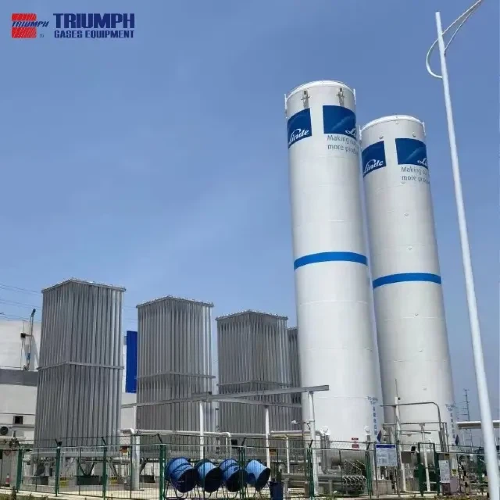
Handling hydrogen at –253°C requires strict safety management and compliance.
International standards define best practices to ensure reliability, such as:
Standard | Issued By | Application |
ISO 21029 | ISO | Cryogenic vessels and tanks |
ASME Section VIII | ASME | Pressure vessel construction |
GB/T 18442 | China National Standard | Cryogenic equipment testing |
EN 13458 | EU Standard | Cryogenic tanks and safety valves |
Vacuum-insulated double walls to prevent heat leakage.
Automatic pressure relief valves for safe venting.
Real-time monitoring systems to detect hydrogen leaks.
Non-sparking materials and explosion-proof control systems.
These design principles minimize risks while maximizing system uptime and performance.
Recent years have seen rapid advancements in cryogenic design and monitoring:
New multilayer vacuum insulation reduces boil-off losses by up to 40%, improving long-term storage stability.
Smart sensors enable real-time performance tracking, ensuring early detection of faults.
Integrated skid-mounted units simplify installation and operation, suitable for hydrogen refueling or satellite plants.
AI systems optimize temperature regulation and predict maintenance schedules, reducing operational costs.
Global hydrogen infrastructure investment expected to exceed $500 billion by 2030.
Japan, Germany, South Korea, and China lead the market in hydrogen adoption.
Region | Key Focus | Market Share (2025 Est.) |
Asia-Pacific | Hydrogen refueling stations & transport | 45% |
Europe | Aerospace & green hydrogen integration | 30% |
North America | Power generation & industrial use | 20% |
Others | Emerging hydrogen economies | 5% |
High liquefaction cost and energy consumption.
Infrastructure standardization and safety regulation alignment.
Skilled workforce training for cryogenic operations.
Despite these challenges, technological progress and global collaboration are rapidly reducing costs and accelerating adoption.
The future of liquid hydrogen equipment is closely tied to the development of a global hydrogen supply chain.
Key directions include:
AI-driven energy optimization in cryogenic systems.
Hydrogen-fueled aviation and heavy-duty mobility.
Decentralized hydrogen microgrids integrated with renewable sources.
International collaboration for standardization and safety frameworks.
As industries push toward carbon-free technologies, the demand for efficient, safe, and scalable liquid hydrogen equipment will continue to grow exponentially.
Liquid hydrogen equipment plays a vital role in driving the global shift toward clean and sustainable energy. From advanced cryogenic storage tanks to fully integrated hydrogen systems, these technologies enable industries to utilize hydrogen safely and efficiently on a large scale.
As a global leader in this field, Wuxi Triumph Gases Equipment Co., Ltd. has spent more than two decades perfecting hydrogen storage and vaporization solutions. With over 117 patents and a strong presence in more than 80 countries, Triumph continues to deliver innovative, high-quality equipment that meets international standards.
To discover more about their expertise or explore tailored liquid hydrogen equipment solutions for your project, consider reaching out to Wuxi Triumph Gases Equipment Co., Ltd. — a trusted partner committed to advancing the clean energy future.
1. What is liquid hydrogen equipment used for?
It is used to store, transport, and convert hydrogen in its liquid form safely and efficiently.
2. Why store hydrogen as a liquid?
Because liquid hydrogen has higher energy density, making it ideal for large-scale storage and transport.
3. What are the key safety measures?
Vacuum insulation, pressure relief valves, leak detection systems, and adherence to ISO/ASME standards.
4. What industries benefit from liquid hydrogen equipment?
Aerospace, automotive, renewable energy, and industrial manufacturing sectors.
5. How does Wuxi Triumph Gases Equipment Co., Ltd. contribute to hydrogen technology?
By offering advanced, patent-backed cryogenic systems and EPC solutions that meet global hydrogen infrastructure needs.


