
close
Choose Your Site
Global
Social Media


Choosing the wrong tank can disrupt production and increase operating costs. So, which Liquid Nitrogen Tank best fits your manufacturing needs? The answer depends on capacity, pressure, withdrawal rate, and insulation. This guide compares tank types, safety features, and lifecycle costs to help you select the right system.
Dewar tanks are often suitable for laboratories, pilot production, and manufacturing processes that use small quantities of liquid nitrogen. Their insulated construction helps limit heat transfer and preserve the stored liquid. A 100 L Dewar, such as the type listed in the supplied product reference, provides one example of this capacity class. Actual usable volume and evaporation performance depend on the specific model and its operating conditions.
These tanks may work well when nitrogen demand is intermittent. Operators can replenish the supply as needed, provided deliveries remain available. However, manual handling and frequent refilling can become inconvenient as production grows. A small vessel may also struggle to support several machines operating simultaneously. Manufacturers should therefore compare daily consumption against usable inventory before selecting this configuration.
A pressurized cryogenic vessel may suit applications that require a controlled liquid or gas supply. Its performance depends on design pressure, outlet arrangement, withdrawal rate, and the equipment connected downstream. A 200 L pressurized tank provides another reference capacity, but its suitability cannot be determined from volume alone.
Manufacturers should confirm the required pressure at the point of use. They must also check whether the tank can sustain the expected withdrawal rate without unacceptable pressure changes. If gaseous nitrogen is required, the system may need a suitable vaporizer and pressure-control equipment. If the process uses liquid nitrogen directly, the transfer system must support the required liquid flow and temperature conditions.
Larger storage tanks are often more suitable for production lines running across multiple shifts. They can hold more inventory between deliveries and may reduce the frequency of replenishment. The actual benefit depends on consumption, delivery arrangements, usable capacity, and storage losses. Oversizing can increase capital costs and may create unnecessary inventory during periods of low demand.
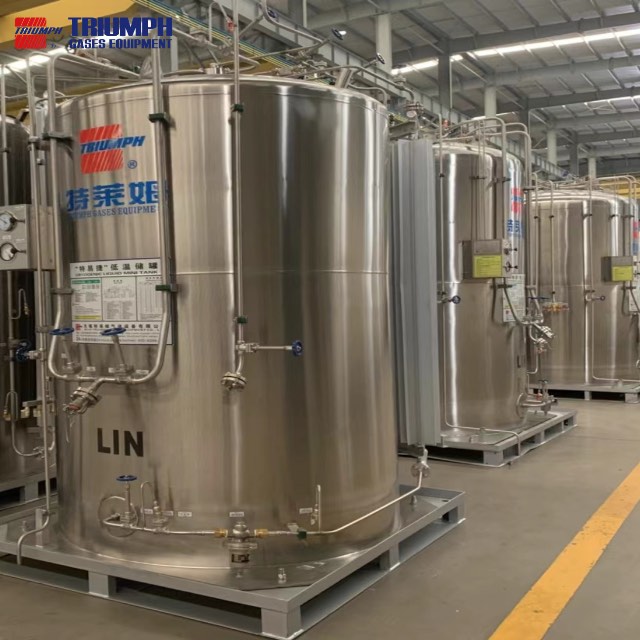
Manufacturers should evaluate the complete storage system rather than the vessel alone. This includes the delivery connection, foundation, distribution pipeline, safety equipment, and maintenance access. A correctly sized industrial cryogenic tank may support higher-volume operations when its specifications match the process requirements.
A centralized installation can supply liquid or gaseous nitrogen to several production areas. It may reduce the need for separate storage vessels and simplify inventory management. However, the distribution network must support simultaneous demand from connected equipment. Pipeline diameter, pressure drop, insulation, valve arrangement, and flow requirements all affect performance.
The design should also allow operators to isolate individual branches for maintenance. Monitoring equipment can help identify abnormal pressure changes or supply interruptions. Before choosing centralized storage, manufacturers should map the location and demand of each nitrogen user. This helps determine whether one shared system or several independent tanks offer better operational flexibility.
The best configuration depends on the process, consumption pattern, and required delivery conditions. Laboratory testing may need only a small Dewar. Batch processing may require a larger vessel or a pressurized supply system. Continuous production may benefit from higher-capacity storage and a properly designed distribution network.
Manufacturers should also consider how demand changes during different shifts. A system sized for average consumption may not meet short periods of peak demand. Conversely, a tank designed around an unusually high peak may remain underused most of the time. A practical selection should balance average use, peak flow, reserve inventory, and delivery reliability.
Frequent refilling, unstable supply pressure, and repeated production interruptions can indicate that the existing system needs review. However, these problems do not always mean the tank is too small. The cause may be insufficient vaporization capacity, restrictive piping, unsuitable pressure controls, or poor delivery scheduling.
Manufacturers should review operating records before replacing equipment. Compare actual consumption, refill intervals, pressure at the point of use, and peak withdrawal rates. This evidence helps distinguish a storage-capacity problem from a distribution-system problem. The replacement tank should address the identified limitation rather than simply provide a larger nominal volume.
Tip: Record daily consumption and peak withdrawal before comparing tank models or requesting supplier quotations.
Capacity planning should begin with actual nitrogen consumption. Manufacturers can collect usage data from production records, equipment specifications, and operating schedules. Daily demand can be estimated by adding the expected consumption of each process. If machines operate simultaneously, the calculation should also account for periods of higher demand. Average consumption alone may not represent the maximum supply requirement.
For example, assume a plant consumes 80 L of liquid nitrogen per production day. It operates five days each week and receives deliveries every two days. Its expected consumption between deliveries is approximately 160 L. This is only a preliminary estimate. The final tank size must also account for usable inventory, delivery delays, storage losses, and any required emergency reserve.
Nominal capacity describes the tank's stated volume. Usable inventory is the quantity available under the actual operating limits. These values are not necessarily equal. Filling limits, minimum operating levels, pressure requirements, and equipment configuration can reduce the amount available for production.
A useful preliminary calculation is:
Required usable inventory = Daily consumption × Days between deliveries + Reserve inventory
Suppose a facility consumes 80 L daily, receives deliveries every two days, and requires a 40 L reserve. The preliminary usable inventory requirement is 200 L. The selected tank may need a greater nominal capacity because its entire internal volume may not be available for routine use.
A 100 L Dewar and a 200 L pressurized tank illustrate two different capacity classes. Neither is automatically better for manufacturing. The Dewar may suit intermittent demand, while a pressurized vessel may provide a more appropriate supply arrangement for connected equipment. Their actual performance depends on construction, operating limits, and manufacturer specifications.
Buyers should compare usable inventory, evaporation rate, withdrawal capability, pressure requirements, and replenishment needs. They should also check whether the equipment is designed for the intended application. A larger tank cannot compensate for an undersized vaporizer or restrictive pipeline.
Refill frequency depends on usable inventory and actual consumption. A preliminary estimate divides usable inventory by average daily demand. However, this calculation does not account for reserve requirements or changes in production. Manufacturers should also consider delivery lead times, transport access, supplier reliability, and seasonal demand.
Tip: Verify usable capacity and maximum permitted filling level in the manufacturer's technical documentation.
Working pressure must suit the connected process. It is different from the vessel's design pressure, which defines the pressure basis used for engineering and compliance. Buyers should identify the pressure required at the point of use and account for pressure losses across the distribution system.
Regulators, valves, and vaporizers may be needed, depending on the application. Their specifications must match the tank and downstream equipment. A tank with a high pressure rating does not necessarily provide the required flow or stable delivery conditions.
Withdrawal rate describes how quickly nitrogen can be supplied. A system may meet average demand but fail when several machines operate together. Manufacturers should check continuous flow requirements and short-term peak demand separately. They should also confirm the conditions under which the supplier's rated performance applies.
For gaseous nitrogen applications, vaporizer capacity can limit the available flow. For liquid withdrawal, the outlet arrangement and transfer conditions become important. The complete supply system must meet the process requirement, not just the tank's nominal rating.
Some processes require liquid nitrogen for direct cooling or cryogenic treatment. Others use nitrogen gas for blanketing, purging, or controlled atmospheres. These applications need different delivery arrangements. Gas supply generally requires an appropriate vaporization and pressure-control system, while liquid delivery requires compatible cryogenic piping and transfer connections.
Manufacturers should define the required phase, temperature, pressure, and flow before selecting equipment. These details help suppliers propose a suitable configuration and avoid unnecessary components.
Insulation limits heat entering the stored liquid. Vacuum-insulated vessels use an evacuated space between vessel walls to reduce heat transfer. Other insulation systems may suit different tank designs and operating conditions. The best choice depends on storage duration, required performance, maintenance needs, and the manufacturer's validated design.
Buyers should request insulation details and relevant performance data. They should not assume that two tanks of equal capacity will have the same heat ingress or storage losses. Construction quality and operating conditions can produce meaningful differences.
Heat entering the tank causes some liquid nitrogen to evaporate. This process is commonly described as boil-off. Its rate depends on insulation performance, tank geometry, ambient conditions, storage duration, and operating practices. Frequent transfers and filling operations may also affect overall losses.
Manufacturers should use the supplier's stated evaporation data when estimating inventory requirements. The test conditions and measurement method should be checked before comparing different models. Actual performance may vary from published figures under different site conditions.
Weekend shutdowns and irregular production schedules can affect storage efficiency. A tank may continue gaining heat even when nitrogen consumption stops. For facilities with long idle periods, the storage duration and expected boil-off deserve particular attention.
Delivery planning can help reduce unnecessary storage time. However, deliveries that are too frequent may increase logistical costs, while deliveries that are too far apart may require excessive reserve capacity. Manufacturers should balance consumption, storage losses, delivery reliability, and operational risk.
Tip: Compare quoted evaporation rates under equivalent conditions before selecting an insulation system.
Liquid nitrogen tanks require pressure protection appropriate to their design and operating conditions. Pressure-relief devices help prevent pressure from exceeding permitted limits. Venting arrangements must also direct discharged nitrogen safely away from workers and occupied areas. The required equipment depends on the vessel design, connected systems, and applicable regulations.
Manufacturers should verify relief-device settings, discharge arrangements, and inspection requirements before commissioning. Operators must never block a required vent or isolate a relief device in a way that removes necessary protection. The installation should follow the tank manufacturer's instructions and approved engineering documents.
Nitrogen is not toxic, but it can displace oxygen in enclosed spaces. An uncontrolled release may create an oxygen-deficient atmosphere without an obvious warning. This risk is important in production rooms, pits, enclosed storage areas, and poorly ventilated locations.
A site-specific risk assessment should determine whether oxygen monitors, alarms, mechanical ventilation, or additional safeguards are required. Their locations and settings should follow the relevant safety assessment and applicable standards. Workers also need training on alarms, emergency response, and safe access to affected areas.
Filling and transfer operations expose workers to extremely cold liquid and vapor. Contact can cause severe cold burns, while splashing may damage the eyes. Suitable cryogenic gloves, eye protection, face protection, and other task-specific protective equipment should be provided.
Maintenance procedures must cover isolation, pressure verification, inspection, and safe return to service. Only trained personnel should perform work on the tank and connected equipment. The manufacturer should provide clear operating instructions, maintenance schedules, and information about approved replacement parts.
注释: Confirm that the installation includes appropriate pressure protection and safeguards against oxygen deficiency.
A suitable tank must fit the site and remain accessible for filling, inspection, and maintenance. Manufacturers should assess the installation footprint, delivery vehicle access, lifting arrangements, and required separation distances. These factors can limit the tank size or influence its location.
The layout should also account for worker movement and emergency access. A tank that fits physically may still be unsuitable if delivery vehicles cannot reach its filling point safely. Site planning should therefore occur before equipment selection is finalized.
The foundation must support the tank and its operating loads. Engineers should consider the equipment's full operating weight, support arrangement, anchoring requirements, and local environmental conditions. Wind, seismic activity, weather exposure, and possible vehicle impact may require additional design measures.
Outdoor installations also need suitable protection against corrosion and physical damage. Inspection access should remain available throughout the tank's service life. Foundation and structural requirements should be confirmed by qualified engineers rather than estimated from tank capacity alone.
Pipeline design affects pressure, flow, thermal performance, and maintenance. Long or undersized lines may restrict delivery, while poorly insulated cryogenic piping can increase heat ingress. Connection materials and components must also suit the required temperature and pressure.
Manufacturers should identify every point of use before finalizing the distribution layout. The design should account for simultaneous demand, isolation valves, pressure regulation, and maintenance access. The tank and pipeline should be evaluated as one supply system.
The initial investment includes more than the tank itself. Buyers may also need vaporizers, regulators, valves, piping, instrumentation, foundations, and installation work. Comparing complete system quotations provides a more useful basis for purchasing decisions.
A lower-priced vessel may require additional equipment or more frequent deliveries. A larger system may reduce delivery frequency but increase installation and capital costs. Manufacturers should compare alternatives using the same capacity assumptions, flow requirements, and safety criteria.
Operating costs include nitrogen purchases, delivery charges, storage losses, inspections, and routine maintenance. Production interruptions caused by supply shortages can also affect overall costs. These factors should be considered over the expected service life.
Buyers can estimate annual costs using actual consumption and supplier quotations. They should include expected boil-off and realistic delivery schedules. Comparing several operating scenarios can reveal whether a smaller tank with frequent deliveries or a larger tank with fewer deliveries offers better value.
Supplier evaluation should cover technical specifications, material certificates, applicable compliance documents, maintenance guidance, and spare-parts availability. Buyers should also confirm warranty terms and the availability of technical support. These details matter when equipment supports continuous production.
Cryogenic equipment suppliers such as TRIUMPH provide product information that can help buyers begin reviewing available configurations. Its industrial cryogenic tank range can be considered when assessing storage requirements. The final selection should still depend on verified specifications and the intended service conditions.
Tip: Request a complete technical proposal covering the tank, accessories, installation requirements, and ongoing support.
Choosing the right Liquid Nitrogen Tank depends on production demand, usable capacity, pressure, insulation, and safety. Careful planning helps reduce supply interruptions and operating costs.
TRIUMPH offers industrial cryogenic tank solutions for different storage needs. Its product range helps manufacturers evaluate suitable configurations for reliable nitrogen supply and long-term operational efficiency.
A: Dewars suit small-scale use, while larger tanks support continuous production.
A: Estimate daily consumption, delivery intervals, and reserve inventory.
A: Effective insulation reduces heat ingress and nitrogen evaporation.
A: Yes. Working pressure and withdrawal rate must match equipment requirements.
A: Capacity, installation, deliveries, evaporation, and maintenance affect total costs.
A: Verify pressure relief, ventilation, oxygen monitoring, and handling procedures.


