
close
Choose Your Site
Global
Social Media


Selecting the correct industrial liquid nitrogen tank requires balancing peak operational demand against the physical realities of cryogenic storage. If you underestimate your facility's daily consumption, you face frustrating production bottlenecks. You will endure frequent delivery fees and risk sudden system dry-outs. Conversely, oversizing creates wasted capital upfront. You also suffer excessive product loss through natural boil-off or evaporation over time. Navigating this critical balance is essential for maintaining smooth, uninterrupted daily operations. This guide breaks down the primary industrial sizing categories available today. We explore critical engineering evaluation metrics and highlight mandatory site implementation requirements. You will learn how to specify the exact equipment your growing facility needs. By understanding peak flow rates, delivery economics, and site constraints, you can optimize your entire cryogenic supply chain efficiently.
Tank sizing must account for both your maximum flow rate and your acceptable delivery frequency, not just total physical volume.
Gross capacity is not usable capacity; safe fill limits dictate that 5–10% of tank volume must remain as vapor space (ullage).
Mid-volume operations often achieve the best ROI by upgrading from liquid cylinders to a Micro Bulk Tank, reducing handling risks and unit gas costs.
Proper sizing requires factoring in pipeline design, Pressure Relief Valve (PRV) requirements, and facility footprint constraints.
Finding the perfect storage size starts with understanding your specific consumption rate. You must balance how much gas you use daily against the equipment's Normal Evaporation Rate (NER). Every cryogenic vessel absorbs some ambient heat. This heat causes the liquid inside to slowly vaporize back into a gas. We call this natural vaporization boil-off. If your daily consumption is too low for a massive vessel, natural boil-off will vent valuable product into the atmosphere. You end up paying for gas you never actually use. Conversely, if you pull too much gas from a small vessel, you will quickly drain your supply.
You also need to understand basic delivery economics. Industrial gas suppliers operate on scheduled delivery routes. They do not typically offer on-demand, same-day refills without charging exorbitant emergency fees. Industry best practices recommend sizing your equipment to hold 1.5 to 2 times your typical delivery cycle consumption. If your supplier delivers every two weeks, your equipment must hold at least three weeks' worth of product. This buffer protects your facility during severe weather delays or sudden production spikes.
Finally, consider your external vaporization needs. Liquid nitrogen expands at a ratio of 1 to 694 when converting back to a room-temperature gas. High-draw applications demand enormous energy to warm this fluid rapidly. If your operation requires massive peak flow rates, small vessels simply cannot provide adequate liquid flow to your external vaporizers. The system will lose pressure, and the vaporizers will freeze solid. Larger units supply higher baseline pressure and consistent fluid withdrawal rates to prevent these catastrophic freeze-ups.
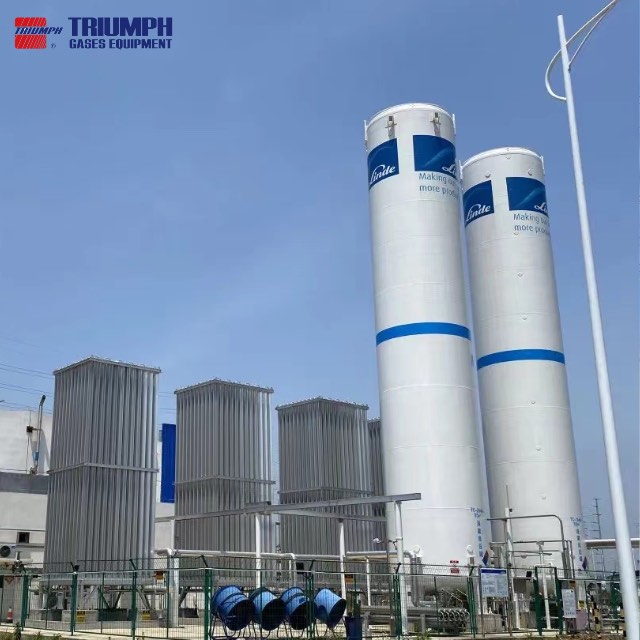
Cryogenic storage solutions fall into three distinct volume categories. Each tier serves completely different industrial applications. You must match your operational scale to the correct equipment tier to maximize efficiency.
Liquid cylinders, commonly known as dewars, represent the smallest industrial storage option. Their size ranges from 50 liters up to 250 liters. They are highly mobile. You can move them around a facility using specialized dollies.
They work best for laboratory environments, dermatology clinics, and localized point-of-use applications. Many low-flow industrial tasks rely on dewars for occasional thermal shrinking or basic freezing tasks. However, they carry severe limitations. Handling them requires intense physical labor and strict safety protocols. You pay a much higher unit cost for gas delivered in small batches. They also suffer from higher relative boil-off rates due to their smaller physical mass.
When operations outgrow dewars, they transition to a Micro Bulk Tank. These units span a size range of 250 liters up to 3,000 liters. They bridge the gap between portable cylinders and massive industrial installations.
This category is best for laser cutting facilities, medium-scale food freezing lines, and growing manufacturing operations. The advantages are highly compelling. They offer permanent onsite installation, which completely eliminates dangerous cylinder changeouts. Gas suppliers fill them directly from smaller delivery trucks called bobtails. Furthermore, most systems include telemetry modules. These modules monitor internal levels and trigger auto-delivery routes before you ever run dry.
Massive continuous operations require an Industrial Gas Cryogenic Tank. These massive structures hold anywhere from 3,000 liters up to 100,000 liters or more.
You will find them at continuous manufacturing plants, large-scale chemical processing facilities, and aerospace testing centers. Massive environmental testing chambers rely on them for rapid, sustained cooling. You can order them in horizontal or vertical orientations depending on your site layout. Installing one requires heavy foundation engineering. They demand dedicated concrete pads, extensive permitting, and heavy-duty crane rigging during initial installation.
Cryogenic Storage Size Categories Chart
Category | Size Range (Liters) | Primary Delivery Method | Best Application Fit |
|---|---|---|---|
Liquid Cylinders (Dewars) | 50 - 250 | Cylinder Exchange | Laboratories, Low-Flow Manufacturing |
Micro Bulk Solutions | 250 - 3,000 | Bobtail Truck Delivery | Laser Cutting, Food Freezing |
Bulk Industrial Installations | 3,000 - 100,000+ | Full Transport Trailer | Chemical Processing, Aerospace |
Selecting a Cryogenic Liquid Storage Tank requires reviewing specific engineering metrics. You cannot base your decision purely on the physical footprint. You must understand how the equipment handles pressure, heat, and fluid withdrawal under heavy industrial stress.
Gross Capacity vs. Net Usable Capacity: Never assume gross capacity equals available product. Liquid nitrogen expands rapidly if ambient heat enters the system. To prevent catastrophic pressure build-up, safety regulations enforce strict fill limits. You must leave 5% to 10% of the internal volume empty. We call this vapor space "ullage." If a unit boasts a 3,000-liter gross capacity, its net usable capacity is roughly 2,700 liters. Always calculate your delivery schedules based on net capacity.
Maximum Allowable Working Pressure (MAWP): Industrial applications demand specific pressure ranges. A laser cutting machine might require 400 psi of continuous gas pressure. A food freezing tunnel might only need 150 psi of liquid pressure. MAWP dictates the absolute maximum pressure the inner vessel can safely hold. You must align the equipment's MAWP with your downstream pressure requirements. Supplying a 500 psi machine with a 250 psi vessel will shut down your entire production line.
Static Holding Time & Insulation: Insulation quality directly impacts your NER. Modern equipment uses vacuum-jacketed multi-layer insulation (MLI) or perlite powder insulation. The outer and inner walls contain a deep vacuum. This vacuum stops conductive heat transfer. MLI uses reflective metallic layers to stop radiant heat transfer. Perlite acts as a physical barrier. Superior insulation extends your static holding time. This time indicates how many days the vessel can sit entirely unused before internal pressure forces the relief valves to open.
Flow Rate Capabilities: High capacities mean nothing without adequate withdrawal rates. You must match the internal withdrawal valves to your peak operational hours. If your facility runs batch processes requiring massive sudden bursts of fluid, standard plumbing will choke. You must specify high-flow valve configurations to prevent pressure drops during peak production times.
Installing cryogenic equipment requires extensive site preparation. You cannot simply drop heavy industrial equipment onto a standard asphalt parking lot. You must evaluate your site layout alongside strict safety compliance standards.
Footprint and Pad Requirements: Liquid nitrogen is incredibly dense. When full, these installations weigh tens of thousands of pounds. You must pour specialized, steel-reinforced concrete foundation pads. Civil engineers must calculate weight load limits assuming the vessel is completely full. You must also account for seismic and wind load ratings specific to your geographic zone.
Piping and Infrastructure Alignment: Moving fluid from the storage unit to your production floor introduces heat. Standard copper or stainless steel pipes will freeze the surrounding air. They will drip excessive condensation and waste your product. You must size and route vacuum-jacketed (VJ) piping correctly. VJ piping minimizes pressure drops and effectively eliminates heat leaks between the source and your point-of-use.
Compliance and Safety Systems: Safety is non-negotiable. Installations must adhere strictly to ASME Section VIII standards for unfired pressure vessels. Because nitrogen displaces oxygen, any indoor routing requires OSHA-compliant oxygen depletion monitors. You must also design properly sized Pressure Relief Valve (PRV) manifolds. If pressure spikes, these manifolds safely vent the expanding gas upward and away from working personnel.
Vendor Accessibility: Refilling requires space. Cryogenic transport trailers are massive, lumbering vehicles. You must ensure adequate turning radii and vertical clearance for these trucks. The fill point should remain easily accessible without blocking your daily shipping and receiving docks. If a vendor cannot safely position their trailer, they will refuse the delivery.
When you approach vendors for quotes, vague requests yield inaccurate pricing. You must provide clear, data-driven specifications. This ensures the vendor quotes equipment capable of handling your true operational workload without upselling unnecessary features.
First, gather your critical data. You need to formulate a precise checklist. Identify your peak Standard Cubic Feet per Hour (SCFH). This metric defines your absolute maximum flow rate. Document your required operating pressure. You must also explain your usage profile. Do you run continuous shifts 24/7, or do you run heavy batch processing twice a week? Vendors use this profile to calculate required vaporizer sizes and optimal MAWP ratings.
Next, evaluate your acquisition strategy. You must weigh buy versus lease models. Purchasing equipment outright represents a significant upfront capital expenditure (CapEx). However, you own the asset and can switch gas suppliers easily. Leasing transitions the cost into an operating expense (OpEx). Gas suppliers often subsidize the hardware cost if you sign a multi-year exclusive gas contract. You avoid heavy upfront costs, but you lock yourself into one supplier's delivery rates.
Finally, move to the next steps. Do not accept rough estimates. Request custom sizing calculations from your shortlisted vendors. Provide them with your specific Piping and Instrumentation Diagram (P&ID) alongside your peak flow parameters. They should return a comprehensive proposal detailing exactly how their proposed hardware handles your exact flow requirements.
Vendor Requirement Checklist
Specification Parameter | Data to Provide Vendor | Why It Matters |
|---|---|---|
Maximum Flow Rate | Peak SCFH (Standard Cubic Feet per Hour) | Determines external vaporizer sizing. |
Operating Pressure | Required downstream PSI | Dictates the equipment's MAWP rating. |
Usage Profile | Continuous vs. Batch operations | Impacts pressure building coil requirements. |
Site Footprint | Available square footage and access routes | Ensures the delivery truck can actually fit. |
Precision in your sizing calculations directly mitigates long-term operational costs. Selecting the proper volume ensures you avoid emergency delivery fees while minimizing daily boil-off losses. You must define your peak flow rates, calculate accurate delivery buffers, and prepare your facility layout carefully. We strongly advise buyers to consult directly with certified cryogenic engineers. You should always validate your internal consumption math before signing a long-term supply contract. By combining accurate data with the right acquisition strategy, you will secure a robust, scalable gas supply system.
A: Start by calculating your peak daily gas volume requirements in standard cubic feet. Convert this gas volume into liquid liters using standard expansion ratios. Multiply that daily liquid volume by the number of days between expected vendor deliveries. Finally, add a safety buffer of at least 50% to handle delivery delays or sudden production spikes.
A: The main differences involve installation footprint and delivery methods. Micro bulk options fit into tighter spaces and receive product via smaller bobtail delivery trucks. Standard bulk installations require massive concrete foundations, complex municipal permitting, and product deliveries from full-sized, heavy commercial transport trailers.
A: You generally avoid indoor installations due to severe safety risks. If forced indoors, you must implement strict facility ventilation. You must pipe all pressure relief valve (PRV) vents directly to the building's exterior. You must also install continuous, OSHA-compliant oxygen depletion monitors to protect personnel from asphyxiation.
A: Product lifespan depends entirely on the Normal Evaporation Rate (NER). Static holding time varies based on physical size and insulation quality. A well-insulated, vacuum-jacketed unit can safely hold unused product for several weeks before internal pressure forces the relief valves to vent gas into the atmosphere.


